Introduction
When selecting a forex broker, traders typically consider spreads, trading platforms, leverage, and currency pairs offered by the brokers. But there is one more crucial factor which may impact your trading experience – the way a broker processes and executes orders.
The terms A-Book, B-Book, and Hybrid refer to various systems of managing clients’ orders and market exposure. Such systems may impact various factors including execution speed, spreads, slippage, liquidity, and conflict of interests.
What should be mentioned is that A-Book is not always better than B-Book and Hybrid is not always safer. There are many other aspects such as regulation, pricing, liquidity, execution policy, and risk management practices which should be taken into account.
There is another point which often confuses traders when selecting a broker – terms like ECN, STP, Market Maker, and DMA. All these terms have something to do with a broker’s structure and its pricing and market access policy, but not with A-Book and B-Book.
Why Broker Execution Matters
The manner in which your broker executes your order can have an impact on how things play out between clicking “Buy” or “Sell” and getting the confirmation of your trade.
Execution time can be very significant for traders who open and close their positions fast. The slippage can impact the ultimate price, particularly in the case of volatile markets. In certain scenarios, traders can face positive slippage, whereas in others they can get a worse deal.
The execution process of the broker can also impact the spreads, liquidity, requotes and trading expenses. These aspects become even more significant in times of high volatility of markets, which happen when there are big economic news releases.
For this reason, traders should take into account execution costs together with others. Understanding Trading Costs: Spreads, Commissions and Slippage will allow you to determine your trading expenses.
What Is a Broker Execution Model?
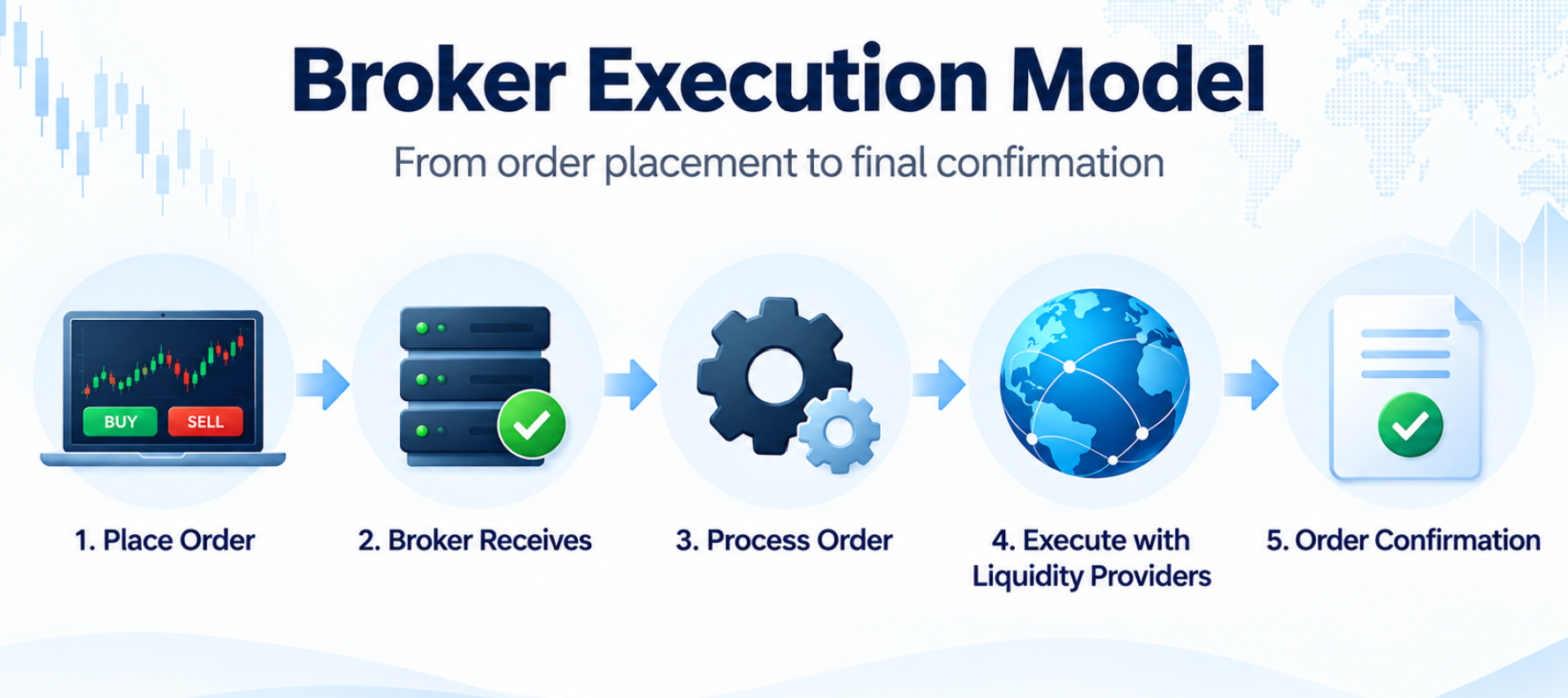
Order Execution Overview
One may consider the basics of forex order execution as follows: placing an order, order reception by the broker, order processing, order execution, and finally, order confirmation for the trader.
In practice, order execution is more complex. It depends on the broker, trading account, currency pair, volume of the order, market conditions, and relationships between the broker and its liquidity providers.
Reasons for Order Execution Models
It is important for a broker to determine the ways of dealing with risk exposure arising due to client trades. It may hold some orders internally, hedge its positions with external counterparties, offset opposite orders of the clients or do all these things in different combinations.
The basic task is to minimize the broker’s risk in the markets in order to offer competitive conditions for the clients.
Role of Liquidity Providers
These can include banks, financial institutions, prime brokers and other institutional counterparties. They can provide the broker with prices and liquidity to execute client orders.
However, all brokers do not use the same liquidity provider scheme. Therefore, a trader needs to check what a particular broker claims.
What Is an A-Book Broker?
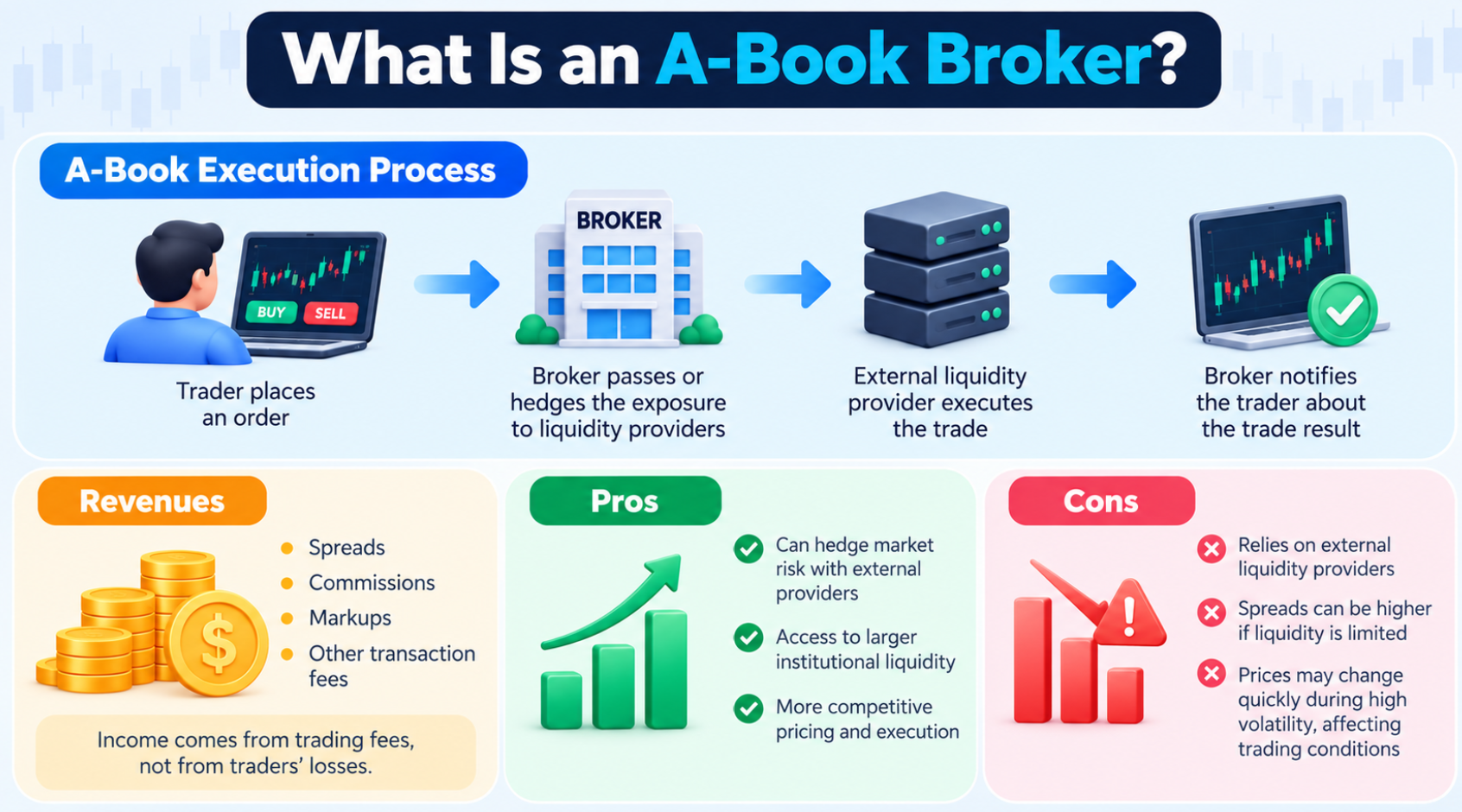
A-Book Execution Process
It is typical for A-Book execution model for brokers to pass or hedge client’s market exposure to external liquidity providers.
For instance, a trader makes a one-lot EUR/USD purchase order. The broker takes the order and sends or hedges the market exposure to an external liquidity provider. The external liquidity provider executes the deal and the broker notifies the trader about the results of the trade.
However, A-Book execution does not imply that all the orders made by the clients are always passed to one external liquidity provider in the same way. There can be aggregation processes, netting, etc.
Revenues
The income of the A-Book broker can consist of the spreads, commissions, markups and other transaction fees. It does not always rely on trader’s losses.
For instance, let us consider a case when the broker gets a one-lot EUR/USD order and passes the market exposure to external liquidity providers. As the broker charges a commission of $5 for each lot traded, the broker will get this amount without any regard to the profit or loss of the trader’s position.
Pros
A possible advantage for A-Book execution strategy is that a broker has the opportunity to hedge market risk or move it outside of his organization. As a result, a broker may have access to a bigger pool of institutional liquidity.
This can be beneficial for the broker in terms of competitive pricing and execution and reduced exposure to individual client’s trades.
Cons
A-Book execution may result in reliance on external liquidity providers. In case there are no enough liquidity providers, it might become more expensive in terms of spreads.
In the event of volatility, liquidity providers can change their prices rather rapidly, and as a consequence, this may impact the trading conditions provided to clients.
What Is a B-Book Broker?
How Internalisation Works
A B-Book approach generally means that the broker internalises client trades instead of immediately hedging every position with an external liquidity provider.
For example, a trader buys EUR/USD and the broker internalises the position. The broker becomes the direct counterparty to the trade. When the trader later closes the position, the broker manages the resulting exposure through its internal risk-management process.
A broker may also have several clients taking opposite positions. Instead of externally hedging every individual trade, it can offset opposing client positions internally and manage only the remaining net exposure.
How B-Book Brokers Make Money
B-Book economics can include spread and commission revenue as well as the results of internalised client flow. When the broker is the counterparty, a client’s trading loss can potentially become a gain for the broker, while a client’s gain can create a corresponding liability.
However, client losses are not necessarily the only source of revenue. Brokers can use netting, risk limits and other strategies to manage their overall exposure.
Advantages
Internalisation can allow brokers to process smaller retail orders efficiently. It may also support competitive pricing and fast execution when the broker has suitable infrastructure and sufficient internal liquidity.
For the broker, managing orders internally can reduce the need to hedge every small transaction externally.
Potential Conflicts of Interest
Internalisation is a recognised business model and is not automatically illegal, unsafe or unethical. The more important issue is how the broker manages potential conflicts of interest.
Traders should consider whether the broker is properly regulated, whether its execution policy is clearly explained and whether it provides appropriate disclosures about how client orders are handled.
It is also useful to examine how the broker manages conflicts of interest and whether its execution practices are transparent. This makes understanding Broker Regulation and How to Check a Broker’s Licence particularly important.
What Is a Hybrid Broker Execution Model?
Combining A-Book and B-Book
A Hybrid broker can combine internalisation with external hedging. Instead of treating every client order in exactly the same way, the broker can decide how to manage exposure based on its overall risk position.
For example, a small retail order might be internalised while a larger order is hedged externally. The broker’s decision can depend on several factors.
Dynamic Order Routing
Trade size, client flow, market conditions, net exposure, the instrument being traded, available liquidity and the broker’s risk limits can all influence how an order is handled.
Imagine two retail traders. Trader A buys 0.1 lots of EUR/USD, while Trader B sells 0.1 lots of EUR/USD. The broker may internally offset these two positions. If another client later buys five lots of EUR/USD, the broker may hedge some or all of that larger exposure externally.
During extreme market volatility, the broker may also adjust its hedging decisions depending on available liquidity and its total exposure.
This is only an example. Actual routing policies vary between brokers.
Why Many Modern Brokers Use Hybrid Models
A Hybrid model gives brokers flexibility. Retail clients can have different trading styles, order sizes and risk profiles, so using both internalisation and external hedging can help a broker manage its overall exposure.
The important point is that traders should understand the broker’s actual execution policy rather than assuming that a particular label tells the whole story.
A-Book vs. B-Book vs. Hybrid: Side-by-Side Comparison
| Feature | A-Book | B-Book | Hybrid |
| Order Routing | Generally externally hedged or routed | Generally internalised | Combination of internal and external handling |
| Counterparty | External liquidity or hedging counterparty | Broker or internal matching structure | Broker and/or external counterparty |
| Revenue Source | Spreads, commissions and markups | Spreads, commissions and internalised-flow economics | Combination |
| Liquidity | External liquidity | Internal liquidity and risk book | Internal and external |
| Conflict of Interest | Generally lower direct counterparty conflict | Requires careful conflict management | Depends on routing and controls |
| Spread Structure | Spread and/or commission | Broker-defined pricing | Varies |
| Typical Users | Traders seeking external liquidity access | Retail flow suitable for internalisation | Broad range of retail clients |
This table describes general models rather than universal broker practices.
Execution Models vs. Broker Types
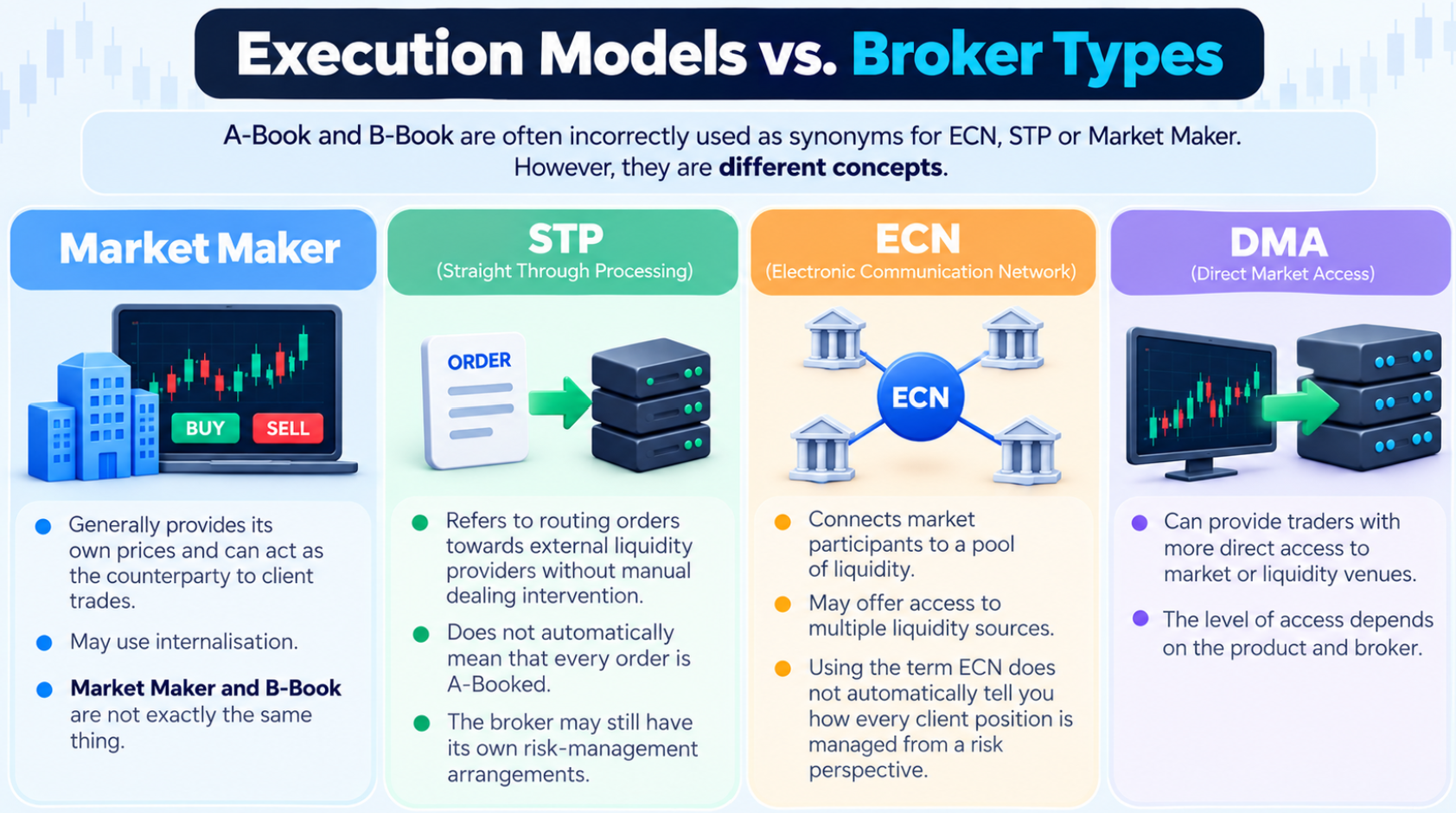
This is one of the most important distinctions for forex traders. A-Book and B-Book are often incorrectly used as synonyms for ECN, STP or Market Maker.
Market Maker
A Market Maker generally provides its own prices and can act as the counterparty to client trades. A Market Maker may use internalisation, but Market Maker and B-Book are not exactly the same thing.
B-Book describes how client flow or risk is managed, while Market Maker describes a broader broker structure and role in providing prices.
STP
STP stands for Straight Through Processing. It generally refers to routing orders towards external liquidity providers without manual dealing intervention.
However, STP does not automatically mean that every order is A-Booked. The broker may still have its own risk-management arrangements.
ECN
An Electronic Communication Network, or ECN, can connect market participants to a pool of liquidity. ECN-style accounts may offer access to multiple liquidity sources.
However, using the term ECN does not automatically tell you how every client position is managed from a risk perspective.
DMA
DMA stands for Direct Market Access. Depending on the product and broker, it can provide traders with more direct access to market or liquidity venues.
The Key Difference
A-Book, B-Book and Hybrid mainly describe how a broker manages and routes client risk and order flow.
Market Maker, STP, ECN and DMA describe different aspects of pricing, liquidity, counterparties and market access.
Therefore, these terms should not be treated as interchangeable.
Practical Trade-Routing Examples
Think of a small EUR/USD buy of 0.10 lots. The broker who follows an A-book strategy would hedge it externally. The broker following a B-book strategy would internalize the trade. The hybrid broker would do so depending on the broker’s risk profile and existing exposure.
What happens when there is a large order of GBP/USD? In such a situation, due to higher exposure created by the position, the broker would either hedge it externally or may manage only a portion of the exposure internally.
Another classic example of orders that go against each other from the perspective of client accounts. Let us say one client has bought one lot of EUR/USD while the other client has sold one lot of it. This will be easily matched by the broker that has adopted internalization. Only the resulting exposure needs to be managed.
The changing market conditions would also play their role in the outcome of the above example. During economic news release, there will be widening of spreads, liquidity problems and slippage.
These examples clearly illustrate the dependence of execution quality on more factors than just the labeling of the broker’s A-book, B-book or Hybrid strategy.
How Broker Execution Affects Traders
Slippage is where the execution price does not match the price that the trader had expected when placing an order. Slippage could be either positive or negative and happens when there is a rapid movement in the markets.
Requotes should also be considered, especially by short-term traders. This happens when the price that the trader wants is no longer available and the broker gives another price.
The speed at which the trade is executed will depend on several factors such as the technology of the broker, network latency and liquidity among others.
Spreads should also be considered. While brokers tend to advertise low spreads, the cost of trading could be much higher because the spread could also include commission, markup and slippage.
Which Execution Model Fits Different Trading Styles?
Scalpers usually need very fast execution, low latency, stable spreads and low slippage. They may also benefit from a clear commission structure.
Day traders generally need consistent execution, competitive total costs and reliable liquidity because they may enter and exit several positions during the same trading session.
Swing traders may place greater importance on competitive spreads, overnight costs, reliable execution and broker stability.
Algorithmic traders should pay particular attention to latency, API or automation support, execution consistency, slippage data and infrastructure reliability.
Long-term traders may place greater emphasis on regulation, broker stability, overall costs, product availability and reliable deposits and withdrawals.
Simple Decision Framework: Which Execution Model Should You Choose?
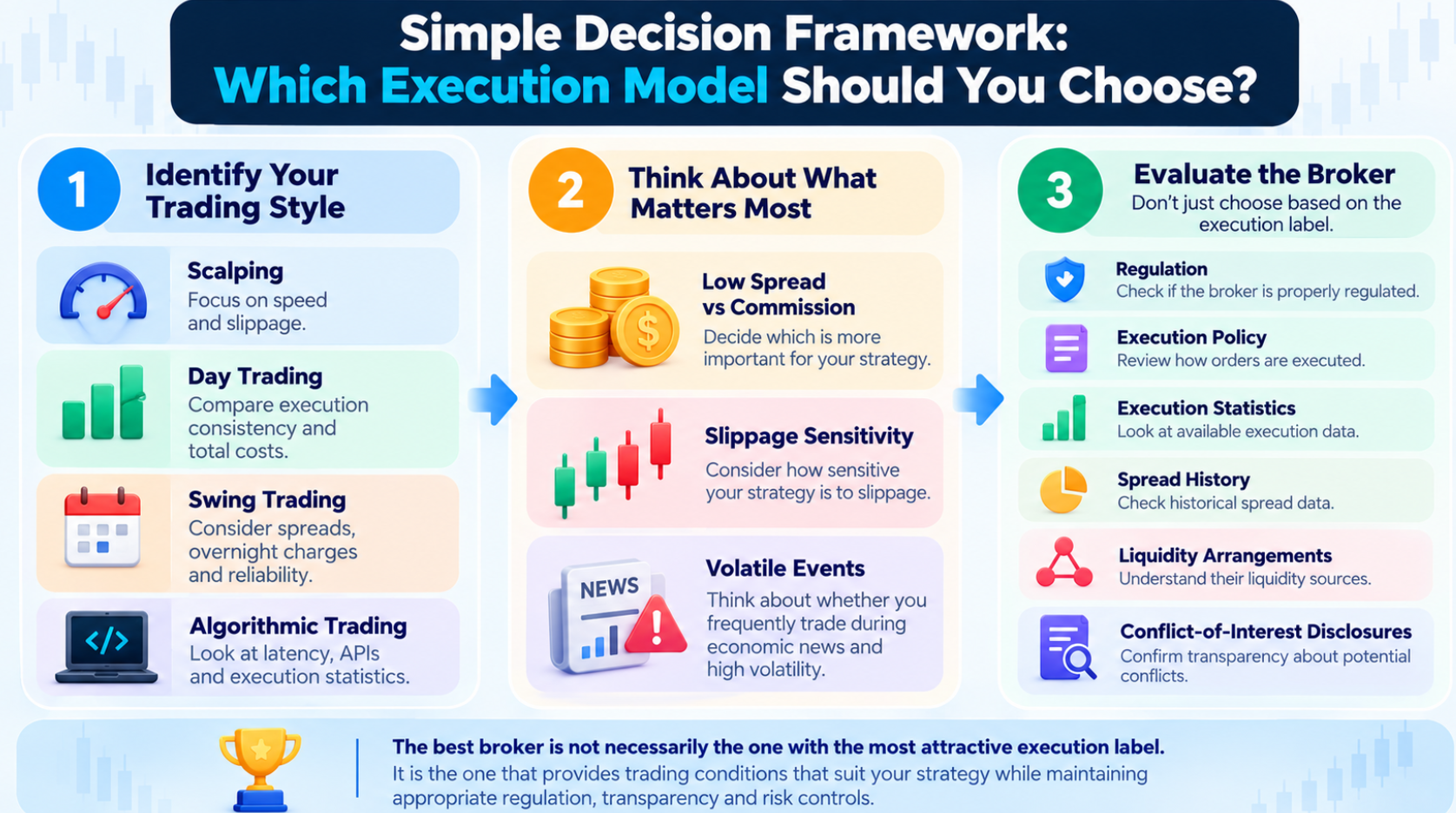
Start by identifying your trading style. If you scalp, focus heavily on speed and slippage. If you day trade, compare execution consistency and total costs. If you swing trade, consider spreads, overnight charges and reliability. Algorithmic traders should examine latency, APIs and execution statistics.
Next, think about what matters most to your strategy. Ask yourself whether a low spread is more important than a commission, how sensitive your strategy is to slippage and whether you frequently trade during volatile economic events.
Finally, evaluate the broker rather than simply choosing an A-Book, B-Book or Hybrid label. Check its regulation, execution policy, available execution statistics, spread history, liquidity arrangements and conflict-of-interest disclosures.
The best broker is not necessarily the one with the most attractive execution label. It is the one that provides trading conditions that suit your strategy while maintaining appropriate regulation, transparency and risk controls.
How to Evaluate Broker Execution Quality
Before opening an account, verify the broker’s regulatory status and licence. Review its execution policy and look for information about average execution speed, slippage and spreads.
If the broker provides information about its liquidity providers or execution arrangements, review that information carefully. Compare typical trading conditions rather than relying only on advertised minimum spreads.
Client reviews can also be useful, but recurring patterns are more meaningful than one isolated complaint. You should also consider transparency reports, conflict-of-interest disclosures and the broker’s overall trading costs.
For a broader assessment, compare these factors alongside Risk Management for Forex Traders and a reliable Forex Broker Comparison.
Frequently Asked Questions
What is the difference between A-Book and B-Book forex brokers?
An A-Book-oriented broker generally hedges or passes client exposure to external liquidity providers, while a B-Book approach generally involves internalising client trades.
Are B-Book brokers safe?
B-Book internalisation is not automatically unsafe or unethical. Regulation, execution policies, transparency and conflict-of-interest controls are more important when assessing a broker.
How do Hybrid brokers work?
Hybrid brokers combine internalisation and external hedging. They may route different orders differently depending on factors such as trade size, market conditions and overall exposure.
Is an ECN broker always A-Book?
No. ECN describes a type of electronic liquidity or market-access structure. It does not automatically explain how every client position is managed.
Is an STP broker the same as an A-Book broker?
No. STP generally describes order processing and routing, while A-Book describes how client exposure is managed.