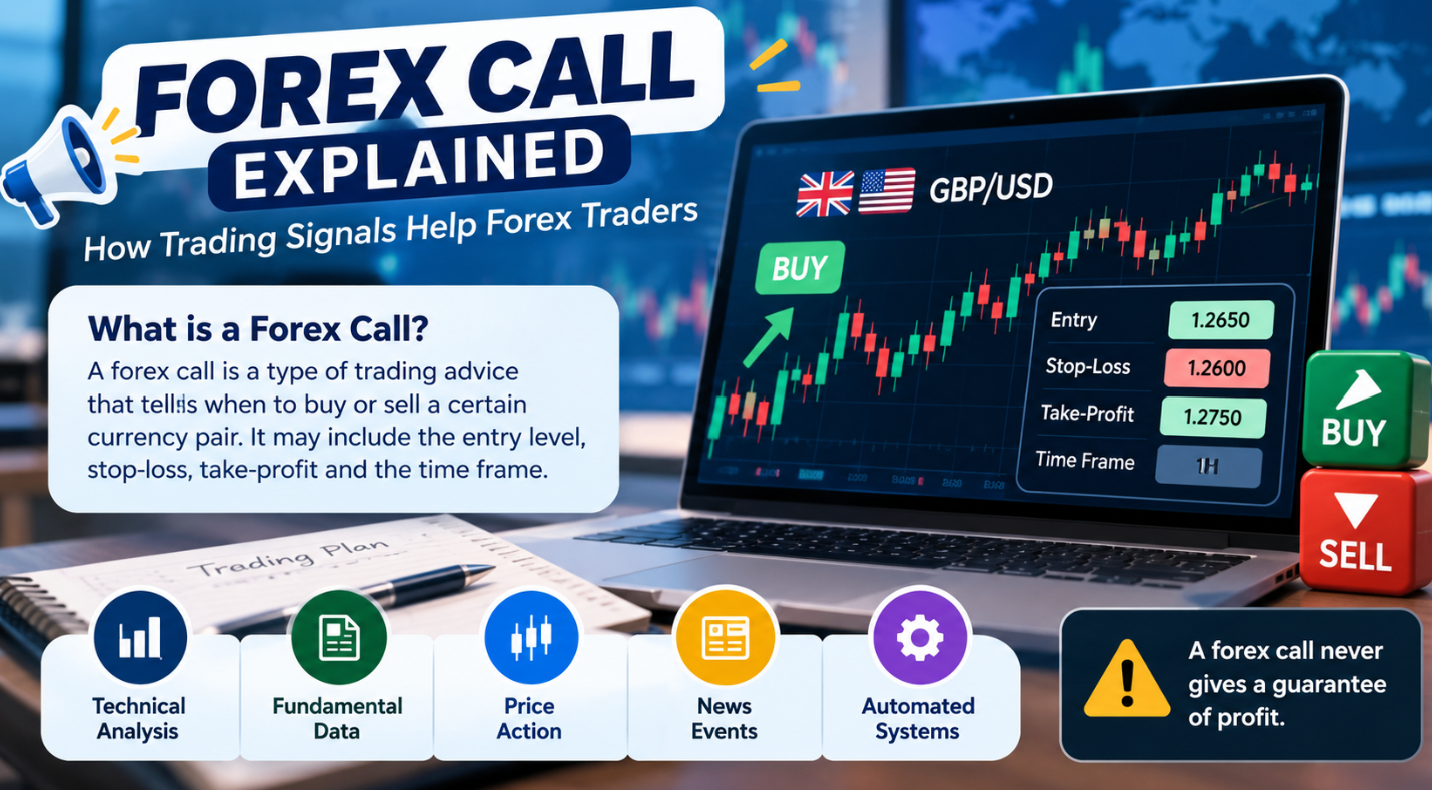
However, it’s not always easy to make an appropriate decision about buying or selling a currency pair, which is why the use of forex call has become so popular among traders who are analyzing the situation. The term ‘forex call’ is often heard in trading forums and chat rooms and yet it rarely receives an explanation. In simple words, a forex call is nothing else but a trade suggestion. Somebody (or even some sort of software) analyzes a currency pair and comes up with a decision of whether this currency is good to trade or not. The call may include only a general statement, like “buy GBP/USD” or it may contain an entry level, a stop-loss, a take-profit point and the time frame of the trade.
Quick answer: Forex call is a type of trading advice, which tells when to buy or sell certain currency pair. It may contain information on the entry level, stop-loss, take-profit and time frame. A forex call may be based on technical analysis, fundamental data, price action, news, automation, but never gives a guarantee of profit.
Key takeaways: A forex trading strategy should be an opinion on whether or not a certain currency pair should be bought or sold, and good strategy will state clearly what the entry point, stop-loss, take-profit, and time frame should be rather than leave it up for trader’s guess. Such opinions may arise as a result of a human analyst analyzing charts and news reports, as well as a computerized system analyzing pre-set criteria, but in any case there are no guarantees that a market will behave the way a signal says it should. Speaking of selection of a signal provider, their success rate advertised on websites is much less important than people think – information on the losses, good risk management, experience and truthful performance statistics matter much more. Also, it is important to understand that free signals are not necessarily bad, while paid ones are not necessarily good.
What Is a Forex Call?
In essence, a forex call is simply a trading idea based on one currency pair and on what particular direction the one who made the call sees the market move. For example, if a provider predicts an increase in EUR/USD in the future, then this call is likely to be a signal to buy the pair. Some calls can be that simple and consist only in telling whether you need to buy or sell the pair. At the same time, there are more detailed calls where you can see the exact entry and stop levels along with the level of take-profit. In general, what a forex call represents is your personal opinion on the movement of price.
If a call states that you should buy the pair, then according to the reasoning behind that call, the price will soon increase, thus allowing you to purchase the asset cheaply. Sell call means the opposite, which is the decline in price of the pair in the future. None of these two types of calls gives you any guarantees as currency prices can go either way after the news or interest rate announcement or after the unexpected political developments.
You’ll also hear the terms “forex call” and “trading signal” used as if they’re interchangeable, and in casual conversation among traders, they basically are. Technically, a call tends to refer to the broader idea — the general sense that a pair is likely to move one way or another — while a signal usually fills in the operational details: the exact price to enter at, where the stop-loss sits, and what the take-profit target looks like. In practice, though, most traders don’t bother drawing a hard line between the two.
How Do Forex Trading Signals Actually Work?
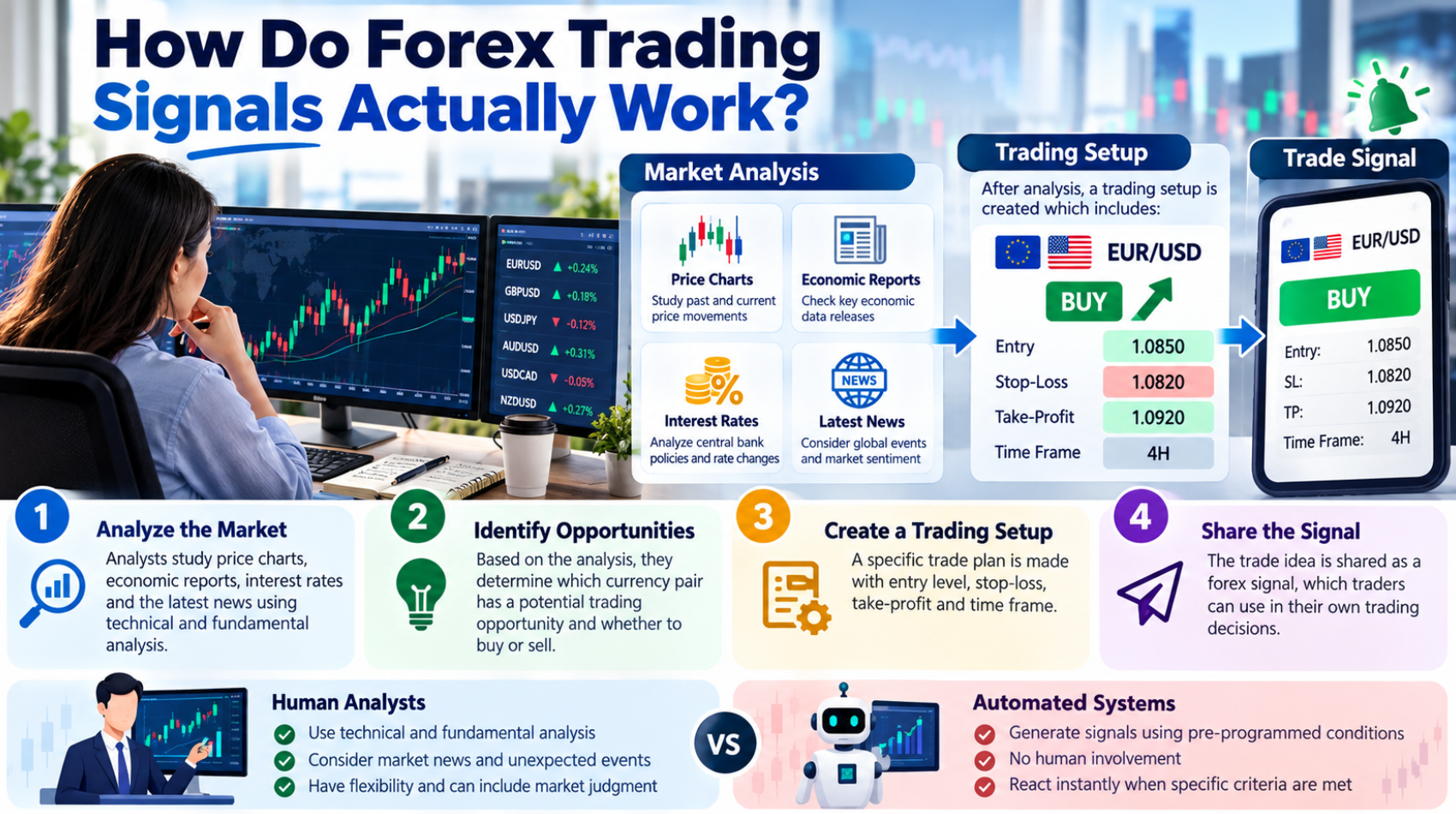
All trades begin with some type of market analysis. The person doing the market analysis could analyze price charts, economic reports, interest rates and the latest news before determining that it would be worthwhile to make a trade. Technical analysis focuses more on price behavior and technical indicators, but fundamental analysis analyzes the external environment, i.e. the economy, and how it affects currency moves. Many trading companies use elements of both types of analysis and do not limit themselves to only one of them.
When market analysis is completed, the next step will be to create a trading setup – the determination of the asset pair that needs to be traded and whether it should be sold or bought. An automated system will generate a setup right after certain pre-programmed conditions are met, without involving any human reasoning whatsoever. In turn, human analysts have much more flexibility – they may include some unexpected development in the market environment.
The entry price tells you where the provider thinks the trade should actually be opened, though some signals give a precise number while others offer more of a range. Because currency prices never stop moving, especially during volatile stretches, what you actually pay when you place the trade can end up a little different from the price originally quoted in the signal. The stop-loss, meanwhile, is there to cap potential losses if the trade goes the wrong way — though it’s worth being clear that a stop-loss doesn’t make losses impossible. Fast-moving markets can cause slippage, meaning your position might close out at a slightly worse price than the one you were expecting. The take-profit level rounds things out, marking where you might choose to exit if the trade goes in your favor, and having both levels defined upfront at least means you know your risk and your target before you ever place the trade.
Here’s a hypothetical example to make this more concrete: a EUR/USD buy call might show an entry at 1.0850, a stop-loss at 1.0800, and a take-profit at 1.0950. That’s 50 pips of risk against 100 pips of potential reward, working out to a 1:2 risk-to-reward ratio on paper. This is purely illustrative — not a trading recommendation — and real prices can behave very differently, meaning any signal, including this one, can still end in a loss.
The Different Types of Forex Trading Signals
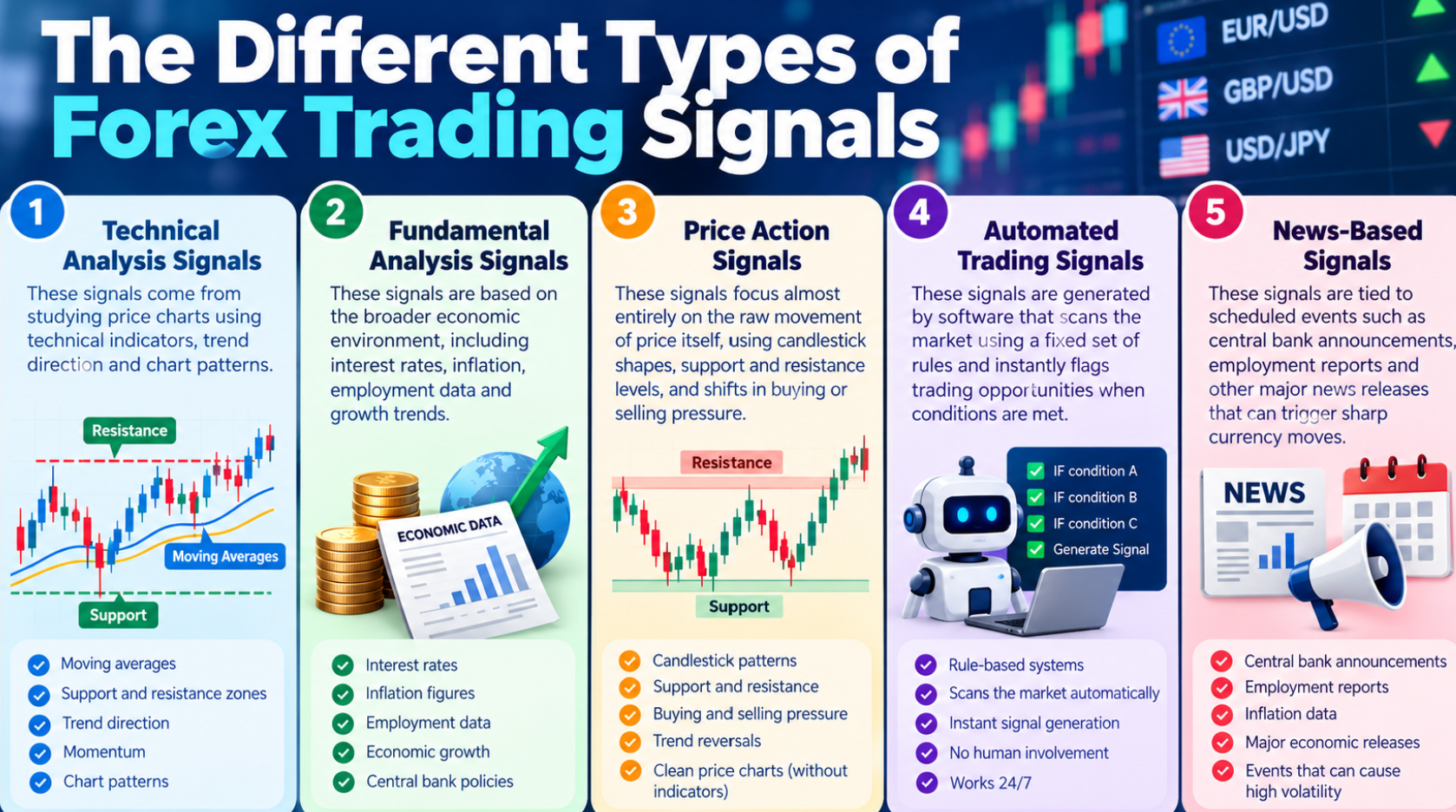
Not all signals are built the same way. Technical analysis signals come from studying charts directly — moving averages, support and resistance zones, broader trend direction, momentum, and recognizable chart patterns all feed into this style of call. Fundamental analysis signals instead zero in on the economic backdrop, using things like interest rates, inflation figures, employment data, and overall growth trends to build a view on where a currency might be headed.
Price action signals strip things back even further, focusing almost entirely on the raw movement of price itself — candlestick shapes, support and resistance, and shifts in buying or selling pressure — often without leaning on technical indicators at all. Automated trading signals come from software scanning the market against a fixed set of rules, flagging opportunities the instant those conditions line up. And news-based signals are tied directly to scheduled events — central bank announcements, employment reports, and similar releases — since these are exactly the moments capable of triggering sharp, sudden moves in currency prices.
It’s also worth understanding the broader split between manual and automated signals. Manual signals come from a human trader bringing their own experience and judgment to the table, which can be valuable, but also opens the door to bias and plain human error creeping into the call. Automated signals, on the other hand, run purely on logic and don’t get emotional about a trade — their real weakness is that they’re only as good as the model and rules behind them, and a system that performed beautifully in one kind of market can fall apart completely once conditions shift.
How Forex Signal Providers Operate
Signal providers usually fall into certain groups. Analyst-based providers use real analysts who study the market and post their calls, usually offering explanations for why they made the certain call, rather than giving an order without it. Algorithmic providers use the help of algorithms, which scan several pairs of currencies all the time and send out a signal as soon as its criteria are fulfilled.
Some signal providers are paid services that send out their signals via a website, an application, an email or any other messenger service used by the provider. There are also plenty of free signal providers, and although they are a good source of information about a signal system structure without having to pay anything for it, one should still consider how the signals are provided and if the provider has any experience behind him.
How to Choose a Forex Signal Provider
Signal providers usually fall into certain groups. Analyst-based providers use real analysts who study the market and post their calls, usually offering explanations for why they made the certain call, rather than giving an order without it. Algorithmic providers use the help of algorithms, which scan several pairs of currencies all the time and send out a signal as soon as its criteria are fulfilled.
Some signal providers are paid services that send out their signals via a website, an application, an email or any other messenger service used by the provider. There are also plenty of free signal providers, and although they are a good source of information about a signal system structure without having to pay anything for it, one should still consider how the signals are provided and if the provider has any experience behind him.
What Separates a Good Signal From a Weak One
A genuinely useful signal clearly spells out the currency pair, the direction of the trade, and the entry level, paired with a stop-loss and take-profit so you know exactly what risk you’re taking on and what you’re aiming for. Beyond that, a good signal gives you the timeframe and some explanation of the reasoning behind the trade — the goal is for you to actually understand the setup, not just follow an instruction blindly without knowing why.
Are Forex Signals Actually Reliable?
Signals can genuinely be helpful, but “helpful” doesn’t mean “always right.” Markets are shaped by an enormous number of moving parts, and even analysts with years of experience can misjudge a situation. Shifting conditions, unexpected news, widening spreads, execution delays, and slippage can all chip away at a signal’s outcome — and a setup that looked promising the moment it was published can look completely different just a few minutes later.
Past performance deserves a similar dose of skepticism. A provider’s historical results can give you some sense of how they operate, but they’re no promise of what comes next. A strategy that performed brilliantly during one stretch of market conditions can struggle badly once volatility, interest rates, or broader trends shift into something different.
Free vs Paid Forex Signals
There’s no single “best” signal that suits every trader — what matters is finding a provider with a clear, explainable method, transparent results, realistic claims, and sensible risk controls, rather than chasing whoever advertises the highest win rate. Free signals can be a solid starting point for beginners trying to understand how a trade setup is structured, without having to pay for the privilege. Paid signals might offer deeper analysis or more consistent updates, but a bigger price tag doesn’t automatically translate into better accuracy. Whichever route you take, it’s worth actually checking the provider’s track record and terms before handing over any money.
Using Forex Calls Responsibly
The healthiest way to treat a forex call is as useful input, not as an automatic instruction to pull the trigger. It’s worth taking the time to understand why a signal was issued in the first place, and checking the market yourself rather than acting purely on faith. Sensible position sizing, properly placed stop-losses, and testing things out on a demo account first can all go a long way toward keeping your risk in check.
That said, following signals isn’t risk-free. Calls can simply be wrong, and changing market conditions, delays, spreads, and slippage can all chip away at results even when the underlying idea was sound. Chasing too many calls at once can tip over into overtrading, and leverage has a way of turning small losses into much bigger ones if you’re not careful.
It’s also worth staying alert to the warning signs of outright scams — promises of guaranteed profits, suspiciously high win rates, pressure to deposit money quickly, and a provider who conveniently never mentions their losing trades. Any of these should make you pause before trusting a provider with your capital.
The Bottom Line
Whatever the source — human, algorithm, free, or paid — no forex call removes the underlying risk of trading. Every signal, no matter how well-reasoned it looks on paper, can still result in a loss. Treat every call as one piece of information to weigh, not a sure thing, and always trade with position sizing, stop-losses, and risk limits that you’d be comfortable sticking to even if the trade doesn’t go your way.
Frequently Asked Questions
What is a forex call?
A forex call is a trading idea that suggests buying or selling a particular currency pair based on market analysis.
What are forex trading signals?
Forex trading signals are indications of potential trading opportunities. They may include an entry price, stop-loss, take-profit and timeframe.
What are forex buy and sell signals?
A buy signal suggests that a currency pair may rise, while a sell signal suggests that it may fall.
How do forex signal providers generate signals?
Providers may use technical analysis, fundamental analysis, price action, news events or automated trading systems.
Are forex signals profitable?
Some signals can lead to profitable trades, but there is no guarantee. Every forex signal carries the possibility of a loss.